
PCB fabrication cost: area, layers, finish and copper
How board area, layer count, surface finish, copper weight and thickness change a PCB fabrication quote, and where a prototype can sensibly save money.
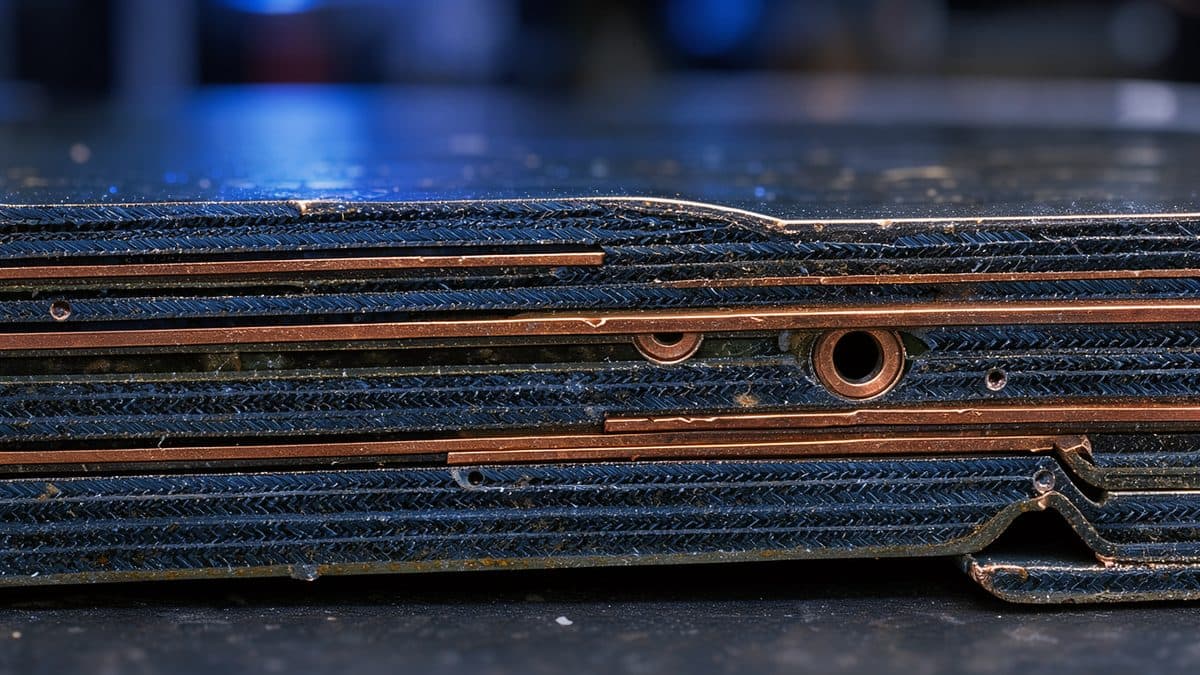
A bare-board quote is less mysterious than an assembly quote. The board has a measurable area, a layer count and a set of process choices. Most of the price follows from those inputs.
Total area, not just board size
Fabrication rates scale with the total area ordered: finished board area multiplied by quantity, expressed in square inches. A 2 × 2 in board is 4 sq in; 50 of them is 200 sq in of production.
This has two consequences:
- Small increases in board size have a linear effect on material and process cost.
- Panelisation can change how efficiently that area is used, even when the finished board is unchanged.
Our calculator asks for the finished outline and handles the area lookup. If you plan to panelise, tell us during review; the price may need adjustment for the panel.
Layer count
Layer count changes both the fabrication setup and the per-area rate. Our instant calculator covers 1, 2, 4 and 6 layers, with multipliers that reflect the additional lamination, drilling and inspection steps. 8-layer boards are available and quoted manually.
Going from 2 to 4 layers is not a small percentage tweak. It is a different stackup and process. If your design can route on 2 layers, the saving is usually larger than any finish or colour choice.
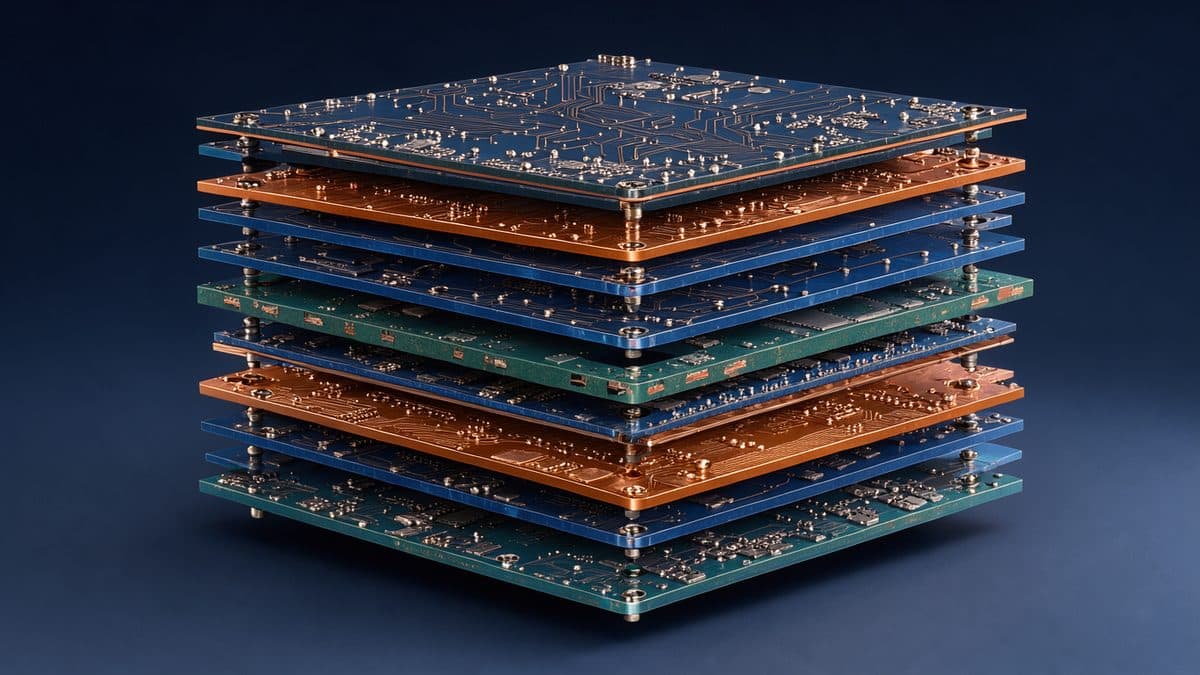
A multilayer stackup is a different process, not simply a doubled two-layer board.
Surface finish
The finish protects copper and provides a solderable surface. Our standard options are:
- HASL — hot-air solder levelling, the default and usually the lowest cost.
- HASL lead-free (RoHS) — lead-free alloy, suitable for RoHS builds.
- ENIG — electroless nickel immersion gold, flatter pads and better for fine-pitch parts and long storage.
ENIG costs more because the process is more complex. It earns its place on fine-pitch boards, exposed pads, press-fit or wire-bonding requirements, and boards that will sit in storage before assembly.
Copper weight
1 oz copper is the default. 2 oz and 3 oz carry multipliers because heavier copper changes etching, plating and process control. 4 oz is available and quoted manually.
Use heavier copper when current, thermal spreading or mechanical robustness requires it. Do not specify 3 oz “for reliability” on a signal board; it adds cost without addressing a real constraint.
Thickness, soldermask and silkscreen
Standard 1.6 mm board thickness is the baseline. 0.8 mm, 2.0 mm and 2.4 mm are available and priced as options. Very thin or very thick boards can affect panel support and assembly, so mention them early.
Soldermask colour is mostly a setup choice. Green is standard; red, blue, black, white and yellow are available. Black can make inspection harder, which matters on fine-pitch boards. Silkscreen on one or two sides is priced accordingly, and custom shapes or internal cut-outs add a routing step.
Electrical test
Electrical test verifies connectivity on the bare board. Our fabrication schedule includes an electrical test fee on 4 and 6 layer boards; 1 and 2 layer boards carry no separate fee in the published calculator.
Test is not a substitute for design review. It catches opens and shorts, not a wrong netlist.
Where prototypes can save
The biggest levers on a prototype are usually:
- Fewer layers, if routing allows.
- Smaller finished area, if the mechanical design allows.
- Standard HASL instead of ENIG, if the assembly process permits.
- 1 oz copper instead of 2 or 3 oz, if current does not demand it.
- Standard green soldermask, if inspection benefits from contrast.
The smallest lever is usually silkscreen. Do not remove it to save a few dollars; it is one of the cheapest ways to prevent assembly errors.
What the calculator does not include
The fabrication price covers the bare board. It does not include:
- Components or assembly
- Stencils
- Shipping, duties or taxes
- Special stackups, impedance control or HDI features outside the listed options
If your design needs one of those, say so in the notes so the review can quote it properly instead of discovering it after the panel is released.
Run your board through the fabrication calculator, then compare the result with the assembly estimate if you need a turnkey build. The two quotes are deliberately separate so you can see what each process costs.
Keep reading
All articles Pricing
What actually drives PCB assembly cost (and what does not)
Two boards with the same area can quote very differently. The reasons are visible in the data if you know which inputs the pricing engine is reading.
Read article Files
The Gerber and BOM checklist we run before every PCB build
Most first-article problems are not manufacturing problems. They are missing data. This is the checklist that catches them before a machine is programmed.
Read article Malaysia
PCB assembly in Malaysia: what a Kuala Lumpur base gives you
Location is not just freight. It changes time-zone response, prototype scheduling and how easily a design can move from first article to production.
Read article