
The Gerber and BOM checklist we run before every PCB build
A practical pre-flight list for Gerbers, drill files, paste masks and BOM data, plus a free BOM template you can send back unchanged.
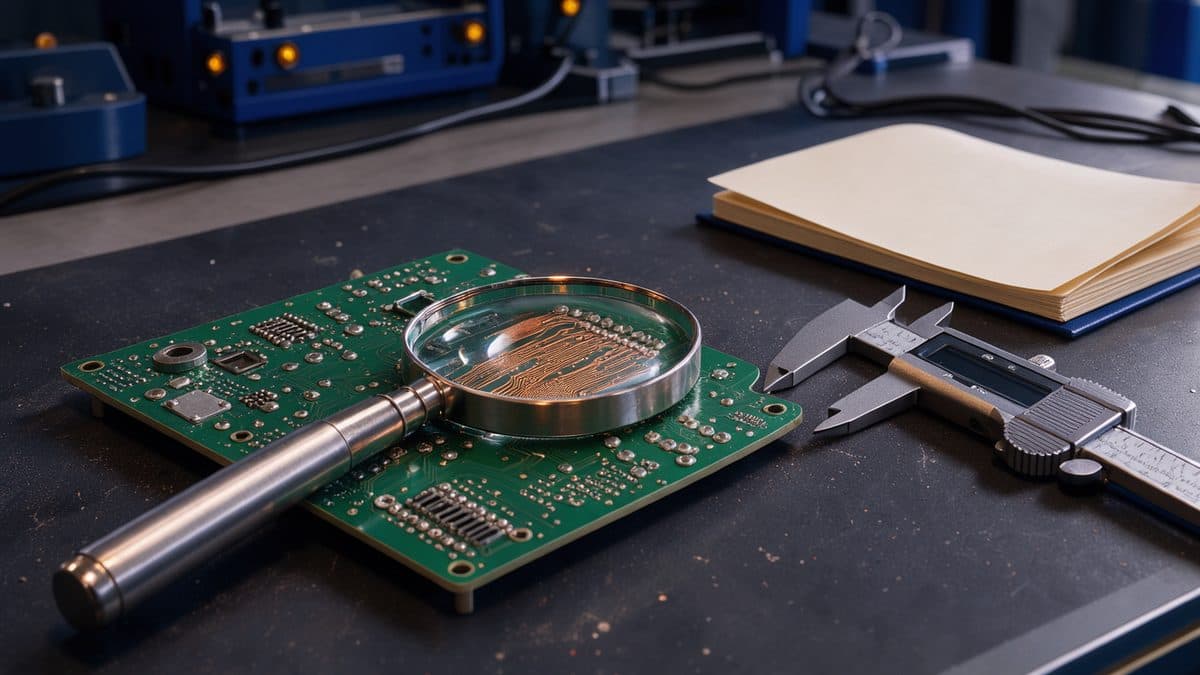
A build starts with files, and files are where most avoidable delays live. The list below is the minimum we want to see before releasing a job. It is also a reasonable checklist to run against any supplier.
Gerber package
Send a single ZIP containing the fabrication and assembly layers. Label layers clearly; do not rely on the fab to guess from file order.
- Copper layers (top, bottom, and inner layers)
- Soldermask, top and bottom
- Silkscreen, top and bottom
- Paste mask, top and bottom — required for SMT assembly
- Board outline on a dedicated layer
- Drill file, including plated and non-plated holes
- Any mechanical drawing or stackup note
Check that the outline is closed and that the drill file uses the same units as the Gerbers. A 1 mm hole interpreted as 1 mil is a bad first article.
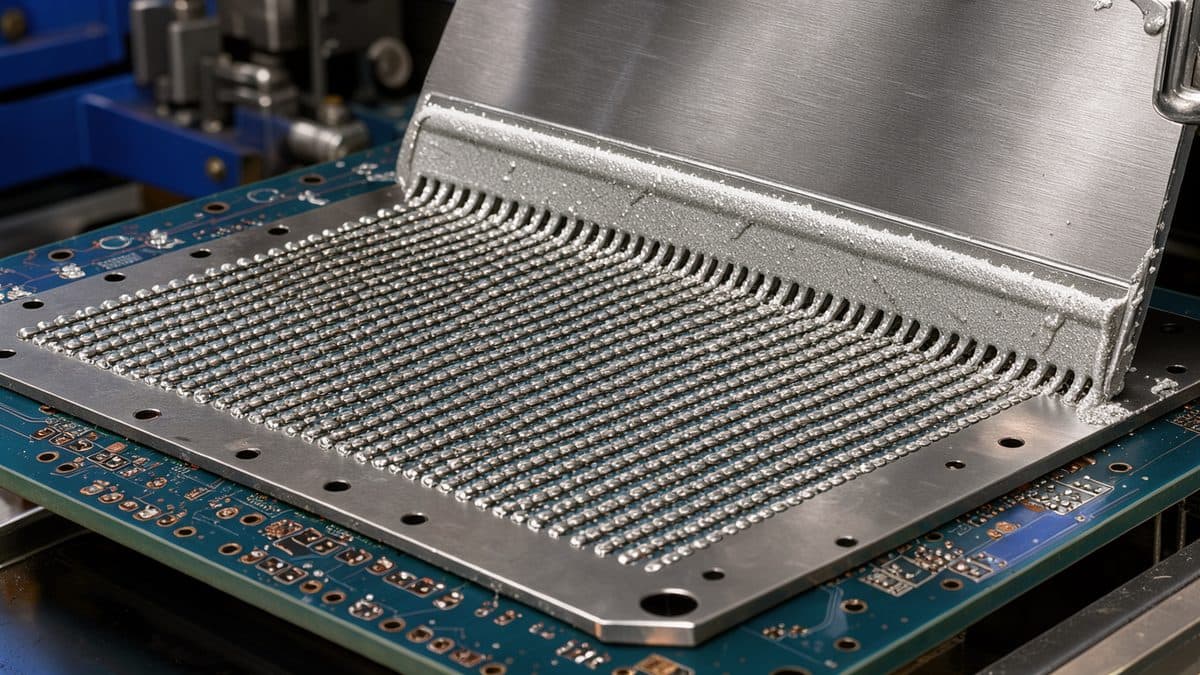
The solder-paste stencil connects the Gerber pads to the assembly process.
Assembly drawing
A simple PDF is enough. It should show:
- First-pin orientation for every IC
- Polarity for diodes, LEDs and polarized capacitors
- Connector orientation
- Any parts that must not be placed (DNP)
- Any hand-solder or selective-solder notes
If the silkscreen already carries this information clearly, say so. The point is to remove interpretation, not to create paperwork.
BOM
One row per unique part. This is the format our BOM template uses, and it is the format our review expects.
Every row needs:
- Quantity per board
- Designator(s)
- Manufacturer and exact MPN
- Description
- Package or footprint
- DNP flag
- Approved alternates, if any
Designators must match the assembly drawing. A BOM that says “R1–R4” while the board says R1–R5 will stop the review.
Do not hide DNP parts by deleting them from the BOM. Mark them. The placement program needs to know the footprint exists but the part is intentionally absent.
Quantity and sourcing
Tell us the board quantity and whether parts are kitted, turnkey or mixed. If the BOM includes customer-supplied lines, mark them per line, not in a covering email.
For kitted builds, include the packaging format: cut tape, reel or tube. Add 3% spares for attrition. Label every bag with the MPN and quantity.
What not to send
- A screenshot of a BOM instead of the spreadsheet
- Gerbers with no paste layers for an SMT build
- A board outline drawn only on the copper layer
- A BOM with “see schematic” in the MPN column
- Multiple revisions in the same ZIP without a revision note
If a revision changes placements or part values, send it as a new package with the revision in the filename. Mixing old and new files is how a correct board gets built to the wrong revision.
A note on panels
If you are supplying a panel, include the panel drawing and the break-away method. If we are panelising, tell us the finished board size and any keep-out or edge-clearance requirements. Panel decisions affect stencil apertures, support tooling and depanelling, so they belong in the quote conversation, not the shipping instructions.
The 10-minute pre-flight
Before uploading, open the ZIP and check:
- Every layer opens and is the right side.
- The outline is closed.
- Paste layers exist for both assembled sides.
- Drill units match the Gerbers.
- The BOM has one row per part and exact MPNs.
- DNP and alternates are marked.
- The assembly drawing shows pin 1 and polarity.
- The file names include the revision.
Then send it through the assembly quote form or the fabrication quote form. If you want a second pair of eyes before submitting, email the package to sales@silvtronics.com and ask for a file review.
Keep reading
All articles Quoting
How to get an accurate PCB assembly quote, first time
A quotation is only as good as the package behind it. Here is the information that changes the number, and the details that quietly delay a first article.
Read article Capabilities
SMT, through-hole, fine pitch and BGA: how complexity changes assembly
The board does not know it is a prototype. Every package on it adds a process requirement, and those requirements are what the quote is really pricing.
Read article Sourcing
Kitted, turnkey or mixed: choosing a PCB assembly sourcing model
Who buys the components changes the risk, the paperwork and the lead time. Here is how to choose without optimising for the wrong number.
Read article