
What actually drives PCB assembly cost (and what does not)
Setup versus per-board build, placement tiers, unique parts, double-sided assembly and the component costs that sit outside the calculator.
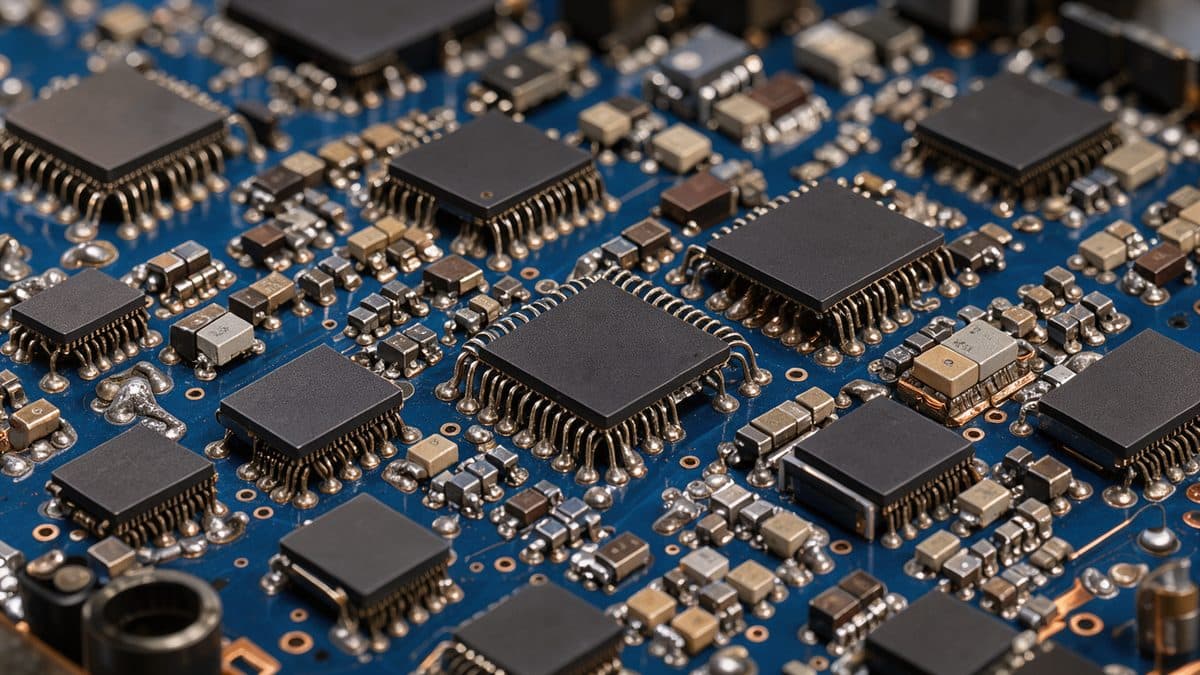
PCB assembly pricing is not a single rate per board. It is a setup charge plus a build charge, and the build charge changes with the number of placements, the package mix and the quantity. Once you can see that structure, most quotes stop looking arbitrary.
Setup is charged once
Setup covers the work before the first good board: stencil preparation, feeder loading, machine programming, first-article checks, and the administrative work of turning a BOM into a build.
In our published rates, the assembly setup includes:
- A base charge when there are SMT, fine-pitch, leadless or BGA placements.
- An increment for unique parts beyond 30.
- An additional charge when through-hole parts or BGAs are present.
- An additional charge for double-sided SMT.
Setup is per order, not per board. That is why a one-board prototype looks expensive per unit and a 100-board run looks much cheaper. It is the same setup spread across more units.
Placements scale the build price
The per-board build price grows with the number of placements. Our rate table also steps down as the total placement count on the order rises: 500 boards × 40 placements is a different scheduling problem from 10 boards × 2,000 placements, even though both are 20,000 points.
The practical consequences:
- Reducing the placement count reduces cost, but only at the margins.
- Reducing the number of unique parts attacks the setup charge, which is often the bigger lever on a prototype.
- Combining two small boards into one panel does not change the assembly point count, but it can change handling and test time.
Advanced packages carry a real premium
Fine-pitch, leadless and BGA parts are priced separately because they change the process:
- Fine pitch needs tighter stencil apertures and more careful paste deposition.
- Leadless packages such as QFN and DFN need accurate placement and often X-ray or underside inspection.
- BGA needs reflow control and inspection that can see under the package.
If you tell us “a few BGAs” without a count, the quote has to assume something. Give the number and the package, even if it is approximate.
Double-sided assembly adds setup — and handling
Two sides means two passes through paste, placement and reflow, plus a decision about which side is built first and how the board is supported. Our setup reflects that. The calculator applies a double-sided setup charge rather than pretending the second side is free.
Quantity and turnaround interact
Four options are shown because quantity and lead time are not independent:
- Base quantity at 10 days
- Base quantity at 15 days
- Double quantity at 10 days
- Double quantity at 15 days
The 15-day option is 90% of the 10-day build price in our rate structure. The trade is scheduling flexibility for a lower build cost. If your deadline has slack, that discount is real; if it does not, paying for the faster slot is the honest choice.
What sits outside the assembly price
The calculator quotes assembly. It does not quote:
- Components
- Bare PCB fabrication
- Stencils (when required separately)
- Shipping, duties or taxes
- Functional test fixtures or programming
Those items are confirmed after the BOM and files are reviewed. A quote that silently bundles components into an assembly rate makes it impossible to see whether the assembly or the parts are expensive.
A worked example
Take a 10-board prototype with 40 SMT placements, 5 through-hole parts, 20 unique parts and one side assembled.
- Setup: base plus through-hole setup — $170.
- Per-board build: SMT and through-hole rates plus the per-board handling charge — $10.40.
- Build total: $104.
- Indicative total: $274.
Double the quantity to 20 boards and the build rises to about $174, while setup stays at $170. The per-board cost falls because the fixed work is spread further. That is the entire logic of the pricing curve.
Run your own numbers in the PCB assembly calculator, then read what to send for an accurate quote before you submit.
Keep reading
All articles Quoting
How to get an accurate PCB assembly quote, first time
A quotation is only as good as the package behind it. Here is the information that changes the number, and the details that quietly delay a first article.
Read article Fabrication
PCB fabrication cost: area, layers, finish and copper
Fabrication pricing is mostly geometry and process. Once you know which inputs move the rate, a board can be designed to fit the budget instead of the other way around.
Read article Lead time
10-day vs 15-day PCB assembly: where the time actually goes
Lead time is not one machine running faster. It is file review, procurement, stencils, programming, queue and test. Knowing the sequence is how you protect a deadline.
Read article