
SMT, through-hole, fine pitch and BGA: how complexity changes assembly
A practical guide to the package types that move a PCB assembly quote, and what each one demands from stencil, placement, reflow and inspection.
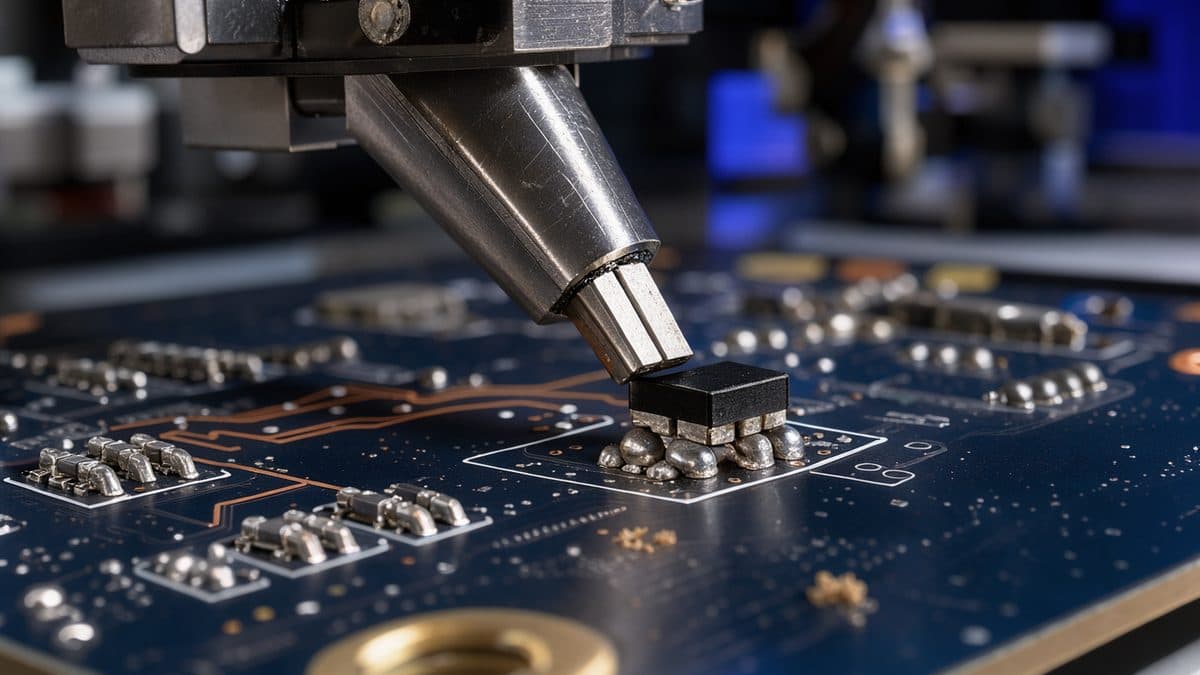
“SMT assembly” covers everything from a 0603 resistor to a 0.4 mm pitch BGA, but those parts do not behave the same on the line. The quote changes because the process changes.
Standard SMT
0603, 0805 and larger passives, SOICs, SOPs and common connectors run on a well-understood process: solder-paste print, placement, reflow, inspection. This is the baseline our calculator assumes.
Standard SMT still benefits from good data. A clear paste layer, correct footprints and a sensible panelisation reduce defects more than any machine setting.
Fine pitch
Fine pitch generally means a lead pitch below 0.021 in. At that spacing, the stencil aperture and paste volume matter more, placement accuracy matters more, and bridging becomes a real inspection item.
What helps:
- A paste layer that matches the actual pads, not a generic footprint
- Panel support that keeps the board flat during printing
- Clear pin-1 marking
- Acknowledged inspection criteria
Fine-pitch parts are priced separately in our rate structure because they consume more process time and attention.
Leadless packages: QFN and DFN
Leadless parts have no compliant leads to absorb placement error. The thermal pad adds another soldering challenge: too little paste and the joint is weak, too much and the part floats or bridges.
Leadless assembly usually needs:
- Accurate stencil apertures for the thermal pad
- A reflow profile suited to the board's thermal mass
- X-ray or underside inspection for prototypes and critical builds
If your design uses QFN or DFN, include the count. “A few leadless parts” is not enough to price the inspection burden.
BGA and uBGA
BGAs hide their joints under the package. You cannot inspect them visually, so the process has to be right the first time.
Key inputs:
- Package pitch and ball count
- Whether the board is double-sided
- Reflow profile and thermal mass
- X-ray inspection requirement
- Any known warpage or via-in-pad issues
BGA counts belong in the quote even when the rest of the board is simple. They also belong in the test plan: a functional test that never powers the BGA interface is not much of a test.
Through-hole and mixed technology
Through-hole parts are often connectors, terminals, relays or power components. They may be hand-soldered, wave-soldered or selectively soldered depending on volume and board layout.
Mixed-technology boards need a sequence: usually SMT first, then through-hole. The sequence affects which side is built first, how the board is supported, and whether some parts must be added after reflow.
Our setup includes a through-hole charge when those parts are present. It is a real process step, not a line item added for decoration.
Double-sided assembly
Two assembled sides means two print/place/reflow cycles. The second pass must not disturb the first, which usually means a reflow profile and support plan that account for the already-populated side.
Double-sided SMT carries an additional setup charge. If only a few parts are on the second side, say so; the plan may be simpler than a full double-sided build, even though the process step still exists.
What to tell us
For each package category, give a count per board:
- SMT placements
- Through-hole parts
- Fine-pitch parts
- Leadless parts
- BGA/uBGA
Then add the things a count cannot capture:
- The densest package on the board
- Any parts that must be hand-placed
- Any connectors with mechanical retention
- Any test or inspection requirement
The assembly calculator turns those counts into an indicative price. Our capability page lists the packages we run, and the file checklist covers the data we need to build them.
Keep reading
All articles Files
The Gerber and BOM checklist we run before every PCB build
Most first-article problems are not manufacturing problems. They are missing data. This is the checklist that catches them before a machine is programmed.
Read article Pricing
What actually drives PCB assembly cost (and what does not)
Two boards with the same area can quote very differently. The reasons are visible in the data if you know which inputs the pricing engine is reading.
Read article Quality
PCB assembly testing: electrical test, AOI and functional test
A board that powers up is not necessarily a board that works. The useful question is which failure modes you are trying to catch before the product leaves the building.
Read article